The Birth Certificate Bond: America's Hidden Fortune or a Generational Myth?
What if the document recording your birth was worth millions of dollars—and nobody ever told you?
For decades, a remarkable claim has circulated in the United States: that every American is assigned a secret financial account at birth, that birth certificates are converted into government bonds, and that the money can somehow be recovered.
To those who believe the claim, it is the story of a hidden fortune. But federal authorities tell a very different story.
So, does the money actually exist? Or is there a legal and logical explanation behind this mystery?
And perhaps the most intriguing question of all:
Where did this story come from?
THE RECORD examined historical legislation, federal court decisions, Treasury records, and the documented evolution of the so-called redemption movement to trace how this extraordinary claim took shape—and why it continues to circulate today.
The Man Who Sued Himself
In 1985, an unusual lawsuit reached the California Court of Appeal. The case was titled Lodi v. Lodi.
The plaintiff was Oreste Lodi. The defendant? Oreste Lodi.
He had sued himself.
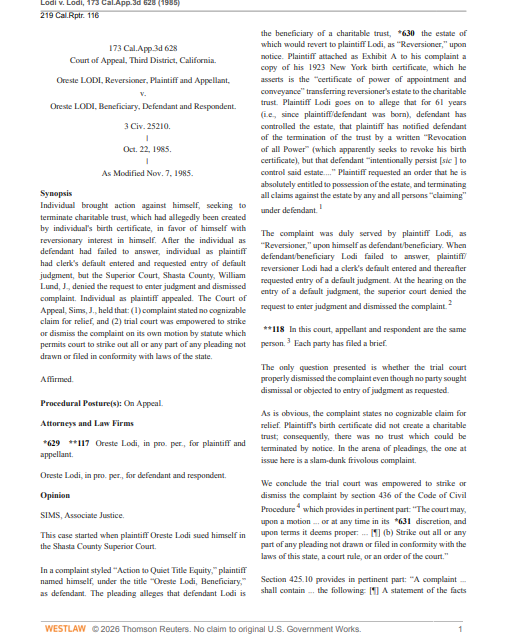
First page of the 1985 California Court of Appeal opinion in Lodi v. Lodi, identifying Oreste Lodi as both plaintiff and defendant in an unusual lawsuit involving a claimed birth-certificate trust.
According to the court's published opinion, Lodi presented a New York birth certificate dated 1923 as evidence that a charitable trust had been created in his name.
By the time his case reached the appellate court, the dispute had already taken an extraordinary turn.
In Shasta County Superior Court, Lodi had identified himself as two separate parties: the Reversioner, who claimed entitlement to an estate, and the Beneficiary, whom he accused of continuing to control it.
He served the lawsuit upon himself. When the defendant—also himself—failed to answer, Lodi obtained an entry of default and requested a judgment.
The court refused.
Lodi appealed, but on October 22, 1985, the California Court of Appeal upheld the dismissal. The judges concluded that his birth certificate had not created the charitable trust he claimed existed.
There was another curious detail. The opinion noted that Lodi had arranged for a copy of his complaint to be sent to the Internal Revenue Service. The judges suggested that he might have hoped to gain some advantage under federal tax law, but his actual purpose was not established.
So who was Oreste Lodi, and where did he get this idea?
The published decision provides only fragments of his personal history. It documents his 1923 New York birth certificate, his California lawsuit, and the legal theory he attempted to advance. It does not establish who taught him the theory or whether he developed it independently.
That distinction matters.
Lodi v. Lodi is one of the earliest published cases THE RECORD has located involving the claim that a birth certificate created a separate trust or estate.
But it does not prove Lodi invented the idea.
What it does establish is that, by the mid-1980s, a version of the theory had already reached an American courtroom.
And within the following decade, related claims about financial redemption would surface in federal cases across the country.
The Redemption Movement: Who Was Roger Elvick?
Seven years after Lodi v. Lodi, another chapter of the mystery appeared in federal court records. This time, the story involved farmers, financial documents, and a man named Roger Elvick.
But who was Elvick, and what was the redemption movement?
Roger Elvick was an American promoter of a financial-redemption scheme that circulated through instructional recordings, written materials, and personal contacts. His teachings claimed that unconventional financial documents and tax procedures could allow individuals to obtain money or challenge financial obligations.
By the early 1990s, his ideas had reached people across several states, including individuals struggling with debt and foreclosure.
One was Norbert Hildebrandt, a Minnesota farmer who experienced financial difficulties during the 1980s. According to a 1992 federal appellate decision, his lender stopped extending additional credit, and his farm was eventually foreclosed upon.
Hildebrandt obtained redemption materials associated with Elvick, circulated by promoters under the title Introduction to Redemption.
He subsequently submitted false tax forms naming individuals he believed were responsible for his financial losses, including people connected to the foreclosure. Hildebrandt was convicted, and the Eighth Circuit upheld his conviction in 1992.
But Elvick's influence extended beyond distributing instructional materials.
In Texas, another man, Emil F. Wiley, worked directly with Elvick on a scheme involving enormous purported tax refunds and fraudulent financial instruments.
According to United States v. Wiley, the two developed a plan in which individuals would claim large IRS refunds and issue documents resembling government payment orders, known as sight drafts.
One document, valued at $990,000, was sent to a business associate in Austin, Texas, with instructions to open a brokerage account and purchase tax-exempt bonds.
The brokerage firm became suspicious and contacted the IRS.
Investigators subsequently arranged an undercover meeting. Wiley arrived with additional drafts and was arrested.
The appellate record documented the partnership, including recorded telephone conversations discussing the arrangement. Wiley was convicted of conspiracy and related offenses, and his convictions were upheld in 1992.
That same year, United States v. Rosnow documented another group of defendants, largely from northwestern Minnesota, whose activities involved Elvick's Redemption Package. On appeal, the Eighth Circuit reversed the defendants' conspiracy convictions, finding that the government had not proved the single overarching conspiracy alleged, while affirming their remaining convictions.
These federal cases reveal an important historical development.
Redemption was no longer merely an unconventional financial theory. It was circulating through instructional materials, reaching financially distressed individuals, and producing real criminal prosecutions.
Yet a crucial distinction remains.
The 1992 cases document fraudulent tax and financial-redemption schemes. They do not establish that Elvick invented the birth-certificate bond theory, nor do they prove that his activities originated with Oreste Lodi.
What they reveal is another documented piece of the historical trail: a movement built around the promise that financial paperwork could unlock money or overcome debts.
How did these ideas eventually become connected to birth certificates, secret government accounts, and the belief that every person possesses a second legal identity?
That question leads us into the next chapter of the mystery.
The Second Identity: How Did a Birth Certificate Become a Fortune?
The name on a birth certificate seems ordinary enough. It identifies a newborn child, records a place and date of birth, and becomes part of that person's official history.
But somewhere along the historical trail, that name acquired an extraordinary second meaning.
According to a theory that would become known as the strawman, the name printed on government documents was not simply a person's identity. It supposedly represented another legal entity—one that could own assets, carry debts, and hold a fortune its living counterpart never knew existed.
Who introduced this second identity into the story? And how did a government record become connected to money?
The answer is more complicated than one law, one court case, or one individual.
By the late 1990s, versions of the strawman argument were circulating within pseudolegal movements. Supporters claimed that a person's name, particularly when written in capital letters, represented an artificial legal identity separate from the living individual.
Under this interpretation, debts and legal obligations supposedly belonged to that artificial identity. Some versions went further, claiming that government records concealed financial assets that could be recovered through special documents or procedures.
The theory offered an intriguing promise: perhaps the financial redemption promoted during the early 1990s was not simply about challenging debts or obtaining refunds. Perhaps, believers argued, there was an account connected to a person's very existence.
But the historical trail did not stop in the twentieth century.
Supporters began invoking much older legislation to explain how such an arrangement could supposedly exist.
One frequently cited example was England's Cestui Que Vie Act of 1666. The law addressed legal problems arising when a person whose life determined a property interest was absent and could not be established as living or dead.
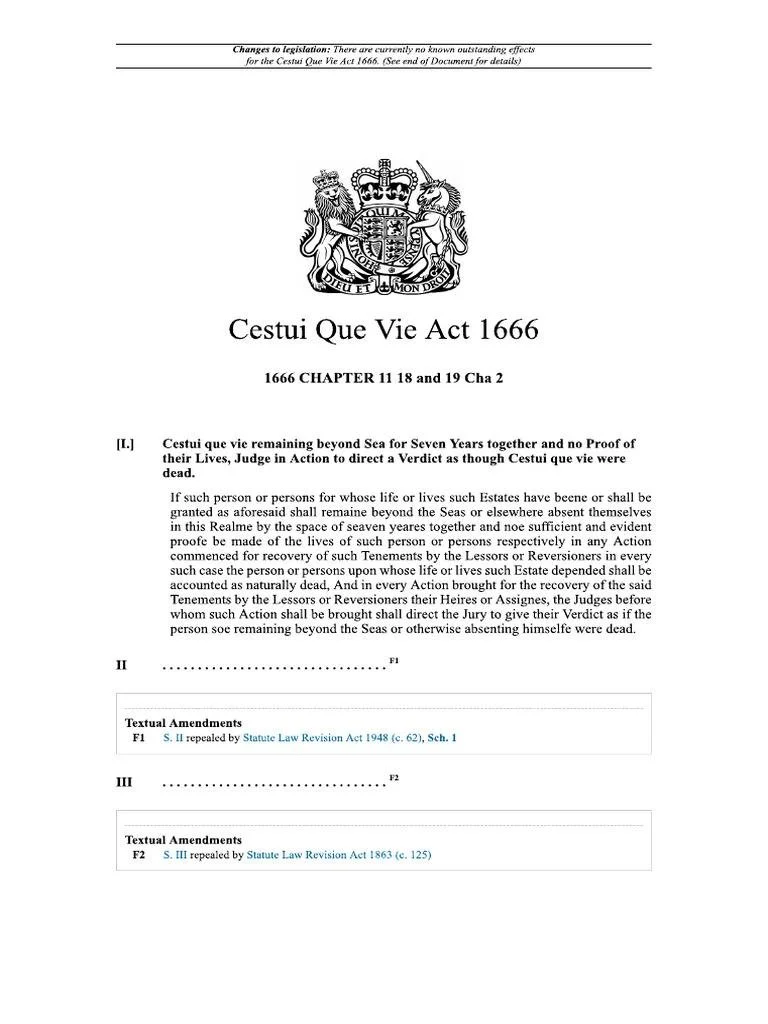
Historical legal text of England's Cestui Que Vie Act of 1666, concerning property rights dependent on the life of a person whose survival or whereabouts were uncertain.
Centuries later, some promoters interpreted the statute as evidence that governments could treat living people as legally dead and administer property in their names.
Another frequently invoked turning point was 1933, when the United States enacted emergency banking legislation during the Great Depression. Some versions of the theory portrayed those monetary changes as a national bankruptcy in which Americans became collateral for government debt.
These interpretations gave the emerging narrative an appearance of historical depth.
But did the laws actually say what the promoters claimed?
The original statutes reveal a different picture. The 1666 law concerned life-dependent property interests and missing persons. The 1933 legislation addressed an economic and banking emergency. Neither established a system of secret financial accounts created through American birth certificates.
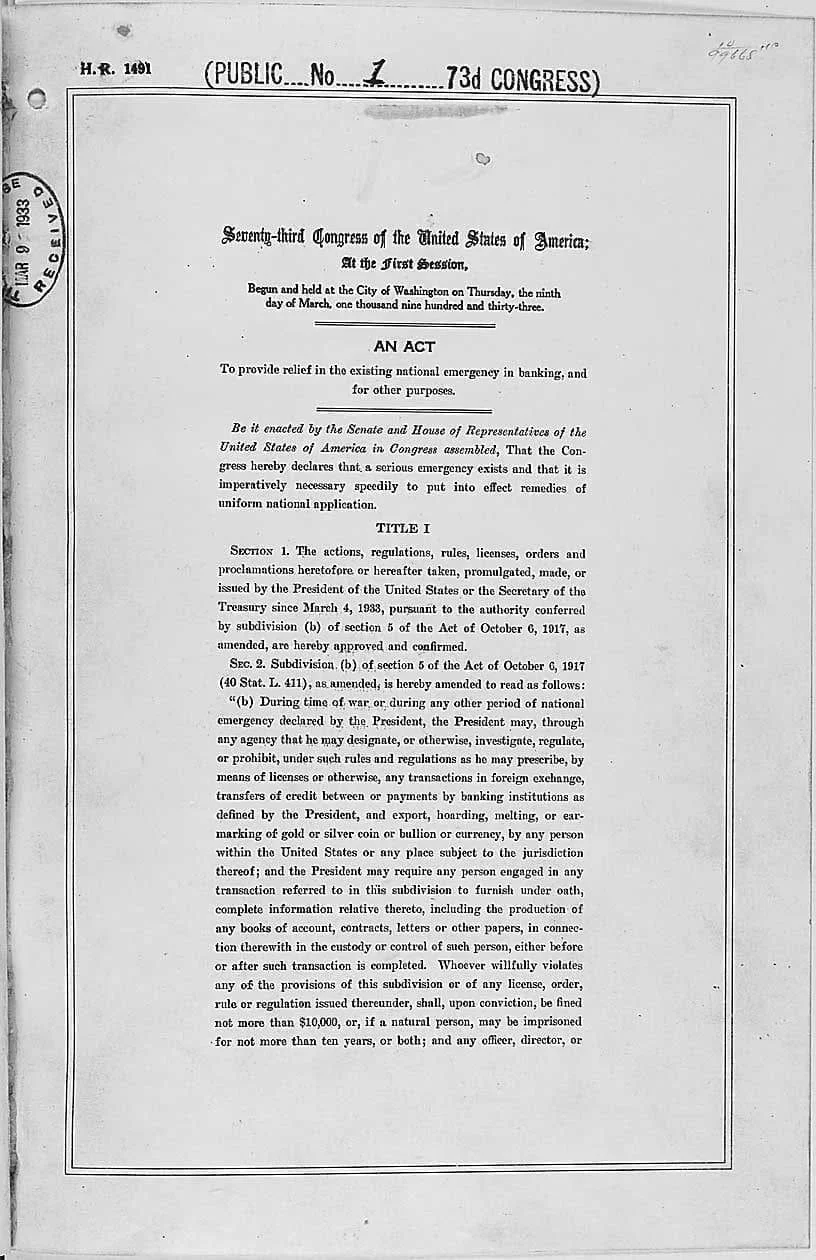
1933 — Congress responds to a national banking crisis. Decades later, the Emergency Banking Act would become part of the birth-certificate bond narrative, despite no documented provision establishing secret accounts tied to birth certificates. Source: U.S. Government Publishing Office.
Nevertheless, the separate ideas—legal identity, redemption, historical trusts, and government finance—became increasingly intertwined.
By the early 2000s, federal tax authorities were confronting schemes that combined claims about government bankruptcy, separate legal identities, and purported financial instruments. The Internal Revenue Service addressed commercial-redemption claims in 2004 and the strawman theory in 2005.
The documentary record shows how these concepts appeared in different settings and eventually became part of a broader narrative. It does not identify the precise moment they were first joined together or prove that one person invented the entire theory.
And that leaves another question.
Why did the idea that human lives could be assigned financial value sound historically plausible to some people?
To examine that question, THE RECORD followed the paper trail even further back—into an era when human beings really were documented, mortgaged, and used as collateral.
That history is real.
But whether it gave rise to the modern birth-certificate fortune story is a separate question—one the surviving evidence must answer.
When Human Lives Were Financial Assets
Long before Americans began questioning whether birth certificates concealed financial value, there was a period in the nation's history when human beings were legally treated as property—and their lives were recorded in financial transactions.
The evidence survives in handwritten documents, mortgages, and bonds.
In the archives of the Smithsonian's National Museum of African American History and Culture is a financial record from Essex County, Virginia, dated 1805. It lists bonds owed to Apphia Rouzee for the hiring of enslaved people, alongside the amounts due.
Another document, dated October 28, 1808, records a debt of ten pounds for the hire of an enslaved man named Jacob.
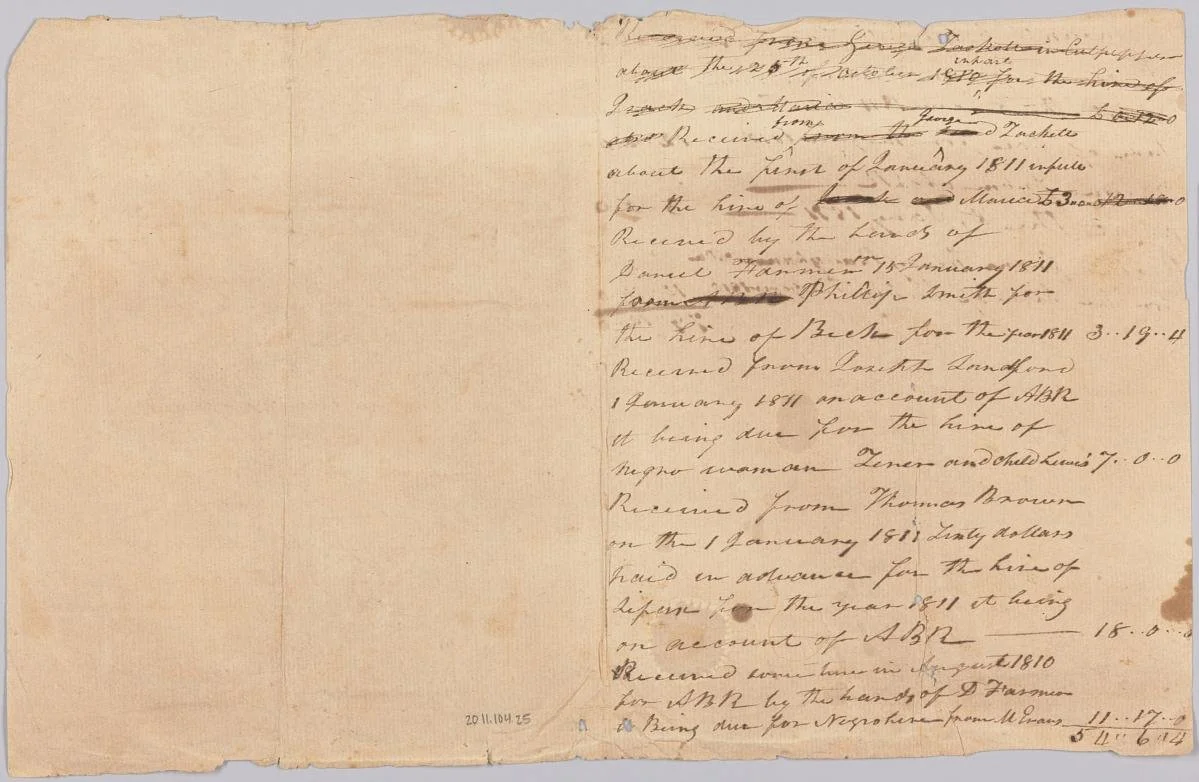
These were not theories about hidden accounts. They were actual financial agreements involving human beings whose freedom had been taken from them.
And the practice extended beyond labor arrangements.
On March 6, 1844, in Charleston, South Carolina, George Lynes executed a document involving the mortgage of four enslaved people identified as Bella, Sally, Ben, and Anthony, for $660.
Their names, a monetary amount, and the transaction were preserved in an official financial record.
For enslaved Americans, the connection between human lives and financial value was not a myth. It was a documented reality.
But does that history explain the modern claim that every American's birth certificate represents a secret government bond?
The distinction is critical.
The historical documents establish that enslaved people were bought, sold, hired out, and used in financial arrangements. They do not establish that today's birth certificates create comparable financial instruments or that the modern redemption movement descended from those practices.
THE RECORD's examination has not identified a documentary connection between these historical transactions and the birth-certificate fortune theory.
The resemblance raises an understandable question, but resemblance alone cannot establish an origin.
So where does that leave the promise of a hidden fortune?
After tracing centuries of legislation, financial records, unusual lawsuits, and redemption schemes, the investigation returns to the document that started it all: the birth certificate.
And to the question that matters most.
The Fortune That Was Never Found
A man who sued himself. A financial-redemption movement that reached federal courtrooms. Centuries-old laws reinterpreted as evidence of hidden trusts. And genuine historical records of human lives assigned monetary value.
Each left a different mark on the story.
But after following the paper trail, THE RECORD returns to its original question:
Does the money actually exist?
According to the United States Treasury, birth certificates are not negotiable financial instruments, cannot be redeemed for government bonds, and do not create secret accounts containing money owed to their holders.
TreasuryDirect specifically identifies the alleged birth-certificate bonds and so-called exemption accounts as fictitious.
A birth certificate records a person's birth. It does not establish ownership of a Treasury security. And a Social Security number, by itself, does not represent an account containing a hidden fortune.
There are legitimate government programs involving financial accounts for children. In 2025, Congress established Trump Accounts, a new type of individual retirement account that can be opened for eligible children under 18 with Social Security numbers. A separate program provides a one-time $1,000 federal contribution for qualifying U.S. citizen children born from 2025 through 2028.
Those accounts are real, governed by published legislation, and subject to defined eligibility requirements. They are not evidence that Americans have secretly accumulated birth-certificate bonds for generations.
So what did our historical investigation uncover?
It uncovered an early birth-certificate trust argument in Lodi v. Lodi, documented financial-redemption schemes associated with Roger Elvick and others, and the later combination of legal-identity theories with claims about hidden government wealth.
What the available evidence did not establish was a secret Treasury fortune—or a single identifiable inventor of the story.
The money promised by the myth remains unsupported. The history of the myth, however, is very real.
Perhaps that is the most revealing discovery.
The birth-certificate fortune story did not need an actual hidden account to survive. It drew upon real laws, real financial terminology, genuine historical injustices, and documented disputes—then connected them in ways the underlying evidence does not support.
The result is a story that continues to invite one irresistible question:
What if something valuable has been hidden in plain sight?
But history demands another question.
Where is the evidence?
And after examining the records, that is where THE RECORD draws the line: between what the documents establish, what people have claimed, and what remains unknown.
Because an extraordinary story deserves more than belief.
It deserves THE RECORD.
CREDIBILITY IS THE CULTURE.